Monday, September 21, 2009

2009 visit to the Petroglyphs site

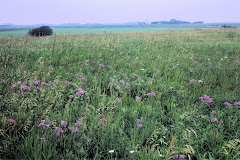
In mid September on a warm afternoon the visitor center was closed. However touring the site is encouraged. Fall flower were showy and bright. The trail led across the gently ascending hillside to the marked walking areas on the rock where the glyphs continue to speak silently to visitors. Lichens crowd some of the rock surfaces. The open prairie rises and falls to distant horizons. The glyphs, the sky and the horizons do not change year after year.

Saturday, September 27, 2008

Visit to the Petroglyphs site

Yesterday we spent several hours at the Jeffers site located just to the west of Comfrey, Minnesota. The Interpretive Staff were working with a busload of children from the Dawson/Boyd school district. We walked the two mile trail that goes through the tall grass prairie and up to quartzire ridge where the primary glyphs are located. It was nearing mid day so the rock drawings are not as evident as in the shadowy time of early morning and near sunset time. The glyphs pictures here were in the same shape as when the pictures were taken in 1996.

The Staff shared information new to me. Apparently some Native Elders are quite concerned that the glyphs and their designs not be used for commercial purposes. The offense is in that the glyphs have spiritual meaning for Native peoples and so the site is to be respected in the same way as a church, synagogue or mosque. Although I am not using them here in a commercial manner, some people may have question about their use in this web log. Here is my rationale.

In my study of world religions, the art and productions of those religions are common knowledge and are used to understand religious history and practice more fully.It is my observation that buildings and artistic creations are in the public realm and are open for observation, study and reflection. Hence, pictures are included on this site. Persons who may be offended need to be in touch with me.

Tuesday, September 23, 2008

More petroglyph photos added

After several months of inactivity, attention is returning to the Jeffers site in that a visit will be paid there later in the week. Additional information will be gathered and will eventually be reflected here.

One of the new pictures shows a surrounding field as it appeared in 1996. This is the year when the glyph photos were taken. Since the pictures were taken additional work has been done on the natural prairie area surrounding the site.

We will be giving special attention to the names of people who have lived on that acreage since it first came into ownership by white settlers. If anyone has more information on this, please send it to Delton.

Tuesday, June 3, 2008

Stonehenge and Jeffers Petroglyphs

The June 2008 edition of The National Geographic features its cover page article entitled "It the Stones Could Speak: Searching for the Meaning of Stonehenge" pages 34-59. The writer is Caroline Alexander and the Photographer is Ken Geiger.

Estimating the time of the creation of Stonehenge to be about 4,500 years ago makes it a near contemporary with the Petroglyph's at Jeffers. The same question cluster about each site. What did the creators have in mind? As the article says "we know little about who these early Britons were, how they were organized, or what language they spoke." More is known in England than in Minnesota about the possible creators because of bones and some artifacts. The various stages of construction at Stonehenge are described in the article. Unearthing Neolithic villages, especially at Durrington Walls, reveals a bit of the life style. The importance of summer and winter solstice observances is understood by the style of the standing stones of Stonehenge.

I read the article with a poignant sense of regret that we know so little of the creators of the Petroglyph's. There are no grand myths of dramatic events out here on the prairie. At this stage we have not learned enough from the geographic setting to project the movement of people following the retreat of the glaciers. To this point, our imaginations are not yet engaged with this challenge - this reaching into the crevices of the mind to mark out the traces of ancient times that continue to be shaped in us by the geography, the weather, the skies above.

Saturday, May 10, 2008

Petroglyphs and Security

The computer and software industry is increasingly turning its attention to security issues. Michael Chertoff, Homeland Security Secretary, recently said that "The potential consequences of a cyber attack are very real and every bit as concerning as the potential of a physical attack on the order of what we saw on September 11". Redmond Developer May 1, 2008

Awareness of this reality has called my mind to the security issues that were faced by those artisans who did the petroglyph's thousands of year ago. Animals, infections, weather, climate, stupity, and angry people would seem have been among the real threats. Strange as it may seem, apparently there was no threat to the messages they were inscribing on the rock. Even more remarkable is the obvious conclusion that over thousands of years no one has gone to the trouble of destroying the rock surface. Either it was just too much work or the point of doing the destruction was not in vogue.

Today business ventures, governments, media, religions, the military and the arts depend on electronic communication using the silicon in computer chips. The silicon has been mined from the earth surface and formed into machines that work using electricity to manipulate numbers and symbols in order to transmit meaning. Rock has been fabricated to enable meaning to fly through space. In earlier times the earth bound rock could not be poached or stolen by enemies so the messages were quite secure.

I believe this fact of life makes it all the more urgent to translate the meaning of petroglyph symbols. We may urgently need ideas that our ancestors had discovered and carved into the quartzite rock for the benefit of coming generations.

Sunday, May 4, 2008

Weather 5000 Years Ago

The Middle Holocene Period was 5000 to 7000 years in the past. Studies are being done to determine what was happening to global weather at that time. In the US Dr. David Leigh of the University of Georgia is quoted in the March 26, 1999 edition of Science Daily saying that some data leads to the conclusion that the in the the US a region from the Southwest through the Dakotas was likely warm and wet. Much of what is now called Canada was yet covered with an ice sheet in this period. We are beginning to see something of the the circumstances that produced weather in the region of the Jeffers Petroglyph's.

Bryan Fagan in "The Great Warming: Climate Change and the Rise and Fall of Civilizations" (Bloomsbury Press 2008) says that the oceans actually are the weather makers for the earth. Currents that move warm and cool water about produce events such as El Ninos or La Ninas. 800 to 1300 AD was the Medieval Warm Period. That era is recent in time. Civilizations in the Pacific, South America, China, Africa, India, and the Arctic illustrate the dynamic powers of the weather to provide for creation and demise of civilizations.

The principles developed in Dr. Leigh's work can be used to consider possibilities for earlier times. Civilizations grew and waned in rhythm with weather that produced people friendly circumstances and also brought droughts that banished people from regions.

Mid continent North America is insulated from the sea by thousands of miles of land but the weather knows no such boundaries. What is learned about the US Southwest can very likely begin to fill in the blanks as regards weather in mid continent. Ocean currents may well help us to understand better the people who developed the Petroglyphs.

Friday, April 25, 2008

Glyphs and Public Diplomacy

Among the possible intentions for creating glyphs may have been group identity issues at stake. Sending a message about "us" and "our way of life" in a certain geographic region must have been a challenging task 5000 years ago.

Today that process of sending messages about "us" is known as Public Diplomacy. The term came into use during the Cold War when the US government unveiled the Edward R. Murrow Center for Public Diplomacy in 1965. International information programs were being developed and it was deemed necessary to move beyond "propaganda".

Public Diplomacy intends to shape the minds of people who observe "us" so that they will be cooperative as we seek out goals in the world. The words Public Diplomacy have an official ring to them. Nicholas Cull of the Annenberg School of International Relations at the U of Southern California spells out the history of Public Diplomacy in the March 2008 issue of The Annals. The task of Public Diplomacy is to create and disseminate ideas that can be spread from person to person in a social network using available technology.

I am suggesting that the Jeffer's Petroglyphs were Public Diplomacy of the time. Available technology was being used by skilled craftspeople to send messages that carried meaning important to the people of the time and beyond. We today are in the position of stretching our mental capacity to grasp what is being made available on the quartzite rocks. Do the messages have anything at all to do with the present human situation? Are ecological issues being addressed? Is management of violence a subject matter? What can artists discover that will enhance the arts of today? What can religions learn that will enhance the spiritual global community? My guess is that glyphs are more than interesting artifacts. Rather, they can open us to needed information from previous human experience.